Across the Southland and beyond the border, LMU Loyola Law School students are advocating on behalf of those who find themselves fighting to be counted.
By Robin Post
.png)
Across the Southland and beyond the border, LMU Loyola Law School (LLS) students are advocating on behalf of those who find themselves fighting to be counted.
From polling stations in Los Angeles to migrant shelters in Guadalajara, Mexico, LLS students are going out in the field to put their legal education to work on projects that go to the very heart of our democracy.
Government Officials for the Day
Scores of LLS T-shirts will punctuate polling locations once again on Election Day, Nov. 3, when student volunteers fan out across L.A. County to serve in a variety of election-monitoring capacities. While some schools have closed for election day, LLS is the first school in the country to continually cancel classes as a way to encourage students to support democracy in action – moving the lessons of democracy to beyond the classroom and into the community of voters who want their voices heard. The effort is one component of LMU’s broader Listen. Engage. Vote. initiative.
Professor Justin Levitt, who organizes LLS’ Election Day program, said that this year is shaping up to be one of the highest turnouts ever. The students are volunteering to serve at more than 60 vote centers and several nonprofits across Southern California.
At the vote centers, students handle everything from setup and voter check-in to closing the polling places at the end of the day and helping resolve issues that arise along the way. Meanwhile, other students work with a slate of L.A. and Orange County nonprofit groups both in person and at hotlines. They watch for signs of trouble and carefully document what they see while answering voters’ questions. Both groups of students receive advance training and are eligible for pro-bono credit for helping eligible voters vote ballots that count.
All this service is immensely important for law students, Levitt said. Serving as a poll worker is one of the few ways any citizen can serve as a government official for a day, and LLS students fill a great need in the community. That’s especially true for students who can speak multiple languages.
Christina Chang ’27 volunteered with LLS Votes in 2024 and is involved again this year, planning to serve as a poll worker on Election Day and helping register students to vote. She believes it’s important for students to be informed about the voting process and to see firsthand how our election system operates.
“Voting is fundamental to democracy, yet confidence in our electoral system is being challenged right now,” she said. “From what I have seen so far, the process is highly structured and carefully designed to protect the integrity of our elections. My experience has given me greater confidence in the electoral process.”
Sitting in a Valencia, California, polling center during the 2024 general election – where she arrived on election eve to help set up – Sascha Macias ’25 summed up her experience: “Everyone should do this at least once."
Jorge Villanueva ’25 said being a poll worker during the “charged” election cycle in 2024 was a great opportunity to get involved in the political process, and he is grateful LLS allows students to take time from their studies to serve the community on Election Day.
“As a fervent believer in our democracy, I believe poll workers are integral to upholding the promises of our electoral process,” he said. “I was honored to contribute to this key position.”
Supporting Migrants’ Journeys
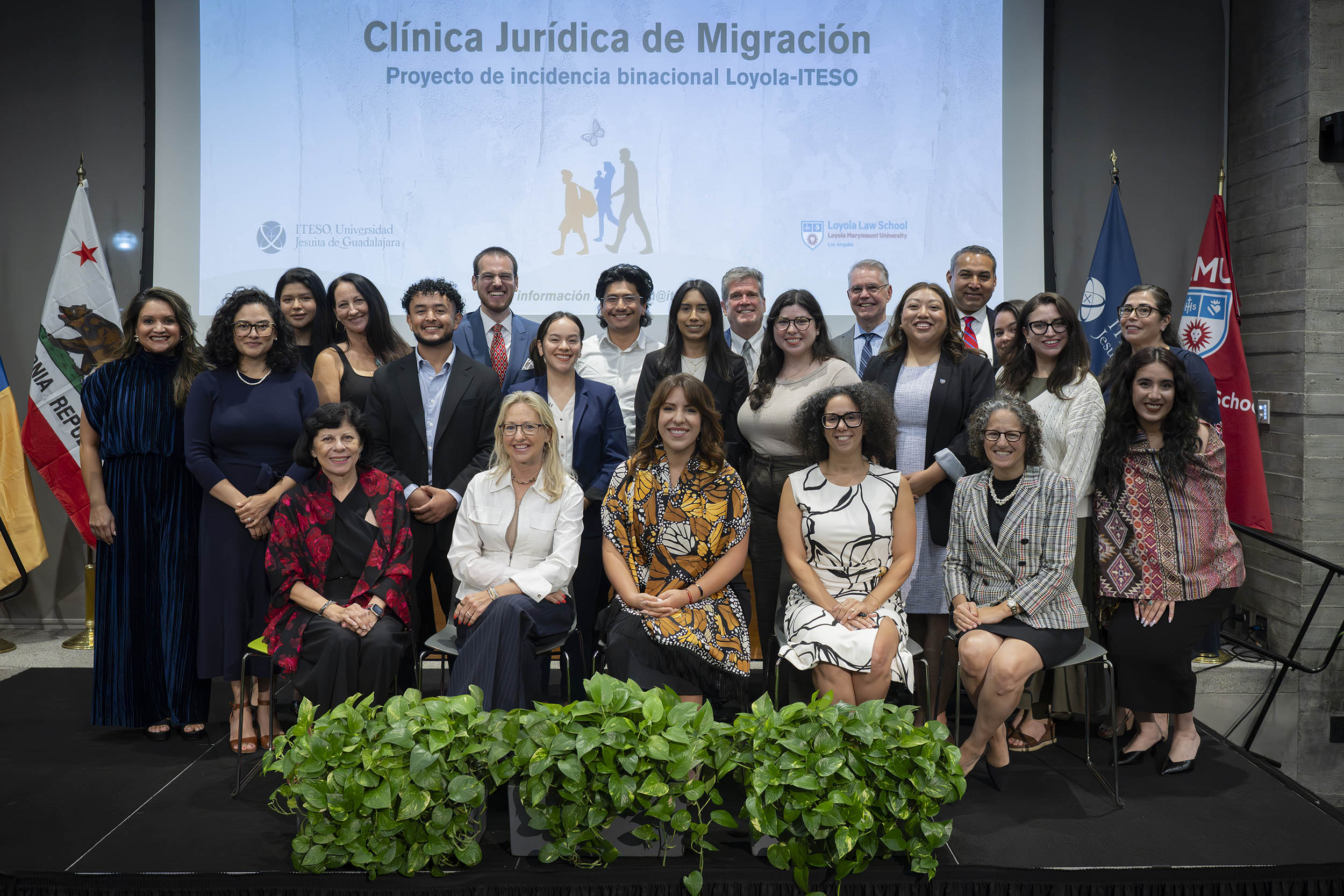
The Binational Migrant Advocacy Project (BMAP) brings students in the Loyola Immigrant Justice Clinic (LIJC) and students at ITESO, Universidad Jesuita de Guadalajara, together to work collaboratively in an international setting to advocate on behalf of migrants on both sides of the U.S.-Mexico border. As the first and only clinic of its kind housed at a U.S. law school, BMAP was created to address the increasingly complex realities of migration between the U.S. and Mexico through cross-border legal advocacy, collaboration, and experiential legal education.
Emily Cervantes ’27 joined BMAP on a service trip to Guadalajara to meet with clients and provide legal assistance to migrants at the border, and said the experience was a “reality check.” In the shelters the city has set up for people from countries all over the world who remain in Mexico because they cannot cross the border into the United States, she saw the consequences of U.S. policies that keep those seeking to legally enter the country out.
"BMAP is able to connect two countries and two legal communities in order to foster communication and resources for those on both sides of the border,” said Cervantes. “This dialogue is very important because law in practice is very different than on paper.”
For Cece Cartledge ’26, BMAP ensures that the government can no longer obstruct viable claims by pushing people "out of sight, out of mind" across borders. “With this tactic, the goal is to deprive people of a meaningful legal process and effectively make them disappear. People do not, however, disappear,” Cartledge said. “Our clients may no longer be in the United States, but their cases are not closed. They refuse to be silenced. We are simply rallying behind them.”
There are glimmers of a better future for migrants, Cartledge said. BMAP is building a network of support, with student advocates helping ensure that clients repatriating to Mexico – or “retorno digno” – have properly prepared themselves and their family members for a legal return to the United States. “Lawyers would have said this was impossible two years ago, but here we are. There is still so much hope.”
Robin Post, associate director of marketing and communication at LLS, is a higher education communicator and writer. Her work has been published by USC, UCLA, Stanford, the Palo Alto Weekly, LA Weekly, and LA STAGE Times. She earned her master's degree in arts journalism from USC.