Simona Grossi proposes new ways to beat back the multi-pronged attack on free speech and protect voices that challenge those in power.
By Michael Blanding
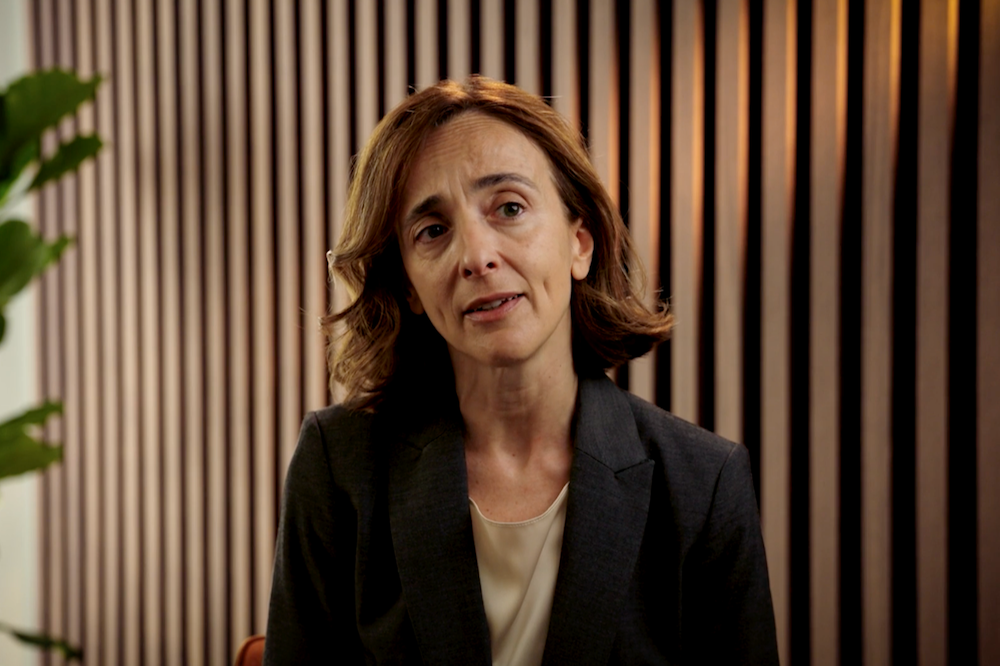
Watch Professor Grossi's Featured Insights video
In mid-September, the Trump administration abruptly announced the ban of three news organizations – CNN, MS NOW, and Politico – from the White House. Its justification for the ban — that the organizations reported “fictions and lies” — seemed patently false and politically motivated, as Trump had made no secret of his dissatisfaction with the views of all three outlets. The move provoked outrage, cries of censorship, and lawsuits filed by the organizations alleging a violation of the First Amendment.
Professor Simona Grossi wasn’t surprised by the ban. For years, she’s been tracing how the Trump administration uses every tool in its power to limit the free speech of those who criticize it or even report uncomfortable facts. The day before the announcement, she delivered law school’s annual Constitution Day lecture on the 239th anniversary of the signing of the U.S. Constitution, citing the famous Supreme Court decision New York Times v. Sullivan, which firmly established the media’s right to report unfavorable news and opinions.
“‘Debate on public issues should be uninhibited, robust, and wide-open,’” she quoted Justice William Brennan from his decision, “‘and that it may well include vehement, caustic, and sometimes unpleasantly sharp attacks on government and public officials.’” In other words, says Gross, a Theodore A. Bruinsma Fellow, “it’s not by silencing speech that we protect our democracy, it is by having more and more speech and confrontation — even more so when it’s political speech.”
As evidenced by recent events, that principle is under attack now more than ever. “When you as an executive decide to ban a broadcaster from the White House because you dislike their speech, and are expressing the idea that this is ‘fake news,’ it’s really the content of the speech you are addressing, and that is attacking democracy,” she says. Indeed, less than a week after the Trump administration’s ban, a federal judge overturned it with an injunction calling it likely unconstitutional.

But that has hardly solved the problem. Such an overt ban has been rare in the administration’s arsenal in its attacks on free speech, says Grossi, who has charted many other subtler ways the Trump administration has chilled the First Amendment for those who challenge him — including law firms that have participated in prosecution against Trump; universities pursuing diversity, equity, and inclusion (DEI); and broadcasters who air critical opinions.
Of those actors, Grossi is particularly worried about the last category because it affects not only media outlets themselves, but also the rights of their audience to hear dissonant voices. “The executive is not just limiting the speech of the speaker, but also the right of a multitude of individuals to hear it,” she says. “That’s devastating.” Grossi’s work lays out these more subtle forms of censorship as well as a plan to combat it.
Censorship in Expression
Grossi grew up in Calabria, the “toe” of Italy, across the Strait of Messina from Sicily.
After earning a law degree from Rome’s LIUSS University in 2002, she worked for a time in Milan at corporate law firms Clifford Chance and Bonelli Erede Pappalardo. She became inspired when she worked her first pro bono case, realizing the skills she gained in corporate defense could be used to protect individual rights. “Because I had learned so well how to fight for the other side, I could be a good advocate for those who couldn’t afford it,” she says. Taking a leave to study for a Master of Laws degree at UC Berkeley in 2009, she became so enamored of academia that she stayed to earn her doctoral degree, then launching her teaching career at Loyola upon completion in 2011.
In addition to the First Amendment, Grossi focuses on civil procedure, the laws that govern how cases proceed in court. Grossi insists those procedures are essential in preserving people’s rights to be heard. “If you do not have access to defend yourself before an impartial judge and present evidence, or if the process if too expensive, you do not have the opportunity to assert your rights.”
That’s what makes the attacks from the Trump administration so dangerous, as they use seeming innocuous procedures to silence other viewpoints, not through direct censorship but through more sophisticated forms of subversion. “We think of censorship as a bureaucrat with a red pen, or a police officer seizing a magazine,” she says. Instead, the administration has identified where organizations depend on government contracts or licenses and exert pressure by threatening revoke that government access and funds. Grossi calls such pressure “expressive governance,” which she describes as “the conduct of the executive using apparently neutral tools to limit the speech of the speaker.”
“If you do not have access to defend yourself before an impartial judge and present evidence, or if the process if too expensive, you do not have the opportunity to enforce your rights.”
For example, after late night host Jimmy Kimmel criticized President Trump, his administration subjected ABC’s broadcast license to early renewal, years ahead of its scheduled renewal in 2028. “Broadcasters depend on licenses to do their business, so there is a relationship of dependency on the federal government,” Grossi says. Even though the government was acting within its authority, the pressure was clear. ABC soon responded by firing Kimmel, only reversing the decision after a public boycott.
In another recent case, Anthropic v. Department of Defense, Grossi wrote an amicus curiae brief to the court in defense of the company, makers of the Claude AI platform. Anthropic refused the U.S. government request to produce software that would potentially allow the executive to spy on American citizens, in contravention of Anthropic’s policies. Soon after, the administration branded the company a “supply chain risk,” threatening to drop its contracts. Anthropic sued in March, winning in August, but overturned on appeal in September.
Whether or not the company was successful is beside the point, Grossi says — just the prolonged attack on the company produces a chilling effect on their and others’ ability to criticize the administration or even simply decline a request. “Other companies know what Anthropic is going through, and don’t want to have the same destiny,” she says.
In a recent L.A. Times editorial based on the case, Grossi proposes a three-step process judges can use to help adjudicate the cases more quickly, avoiding prolonged reputational harm. First, she proposes, judges should ask under what legal authority the government is acting, and whether it matches the actual intent of Congress. For example, the president couldn’t just say something violates national security but would have to show a judge — in chambers if necessary — how it violates it. “This is a system of checks and balances, not a police state,” Grossi says. “If the government says this is a national security issue, then the courts can say, ‘Show me.’”
Secondly, judges should ask if the government has acted in the same way toward other entities in a similar state of dependency — or singled out this actor for special treatment. In answering that question, Grossi says, the judge should look beyond the court record to public statements or media reports that may reveal the government’s intent. For example, even as the administration was attacking Anthropic, Defense Secretary Pete Hegseth denounced the company’s “arrogance,” “rhetoric,” and “ideology” — all labels that seem to go beyond mere national security concerns to imply an attack on its free speech.
Lastly, judges should ask if the impacted organization disseminates information to others, such as a media outlet, making it especially crucial that its speech is protected. By asking these three questions, Grossi says, judges could make a quicker analysis of the case without having to go through the weeks or months of a formal process before deciding whether an injunction is necessary. “A negative answer to the first question — absence of congressional or constitutional authority — would allow judges to avoid engaging in more complex and time-consuming constitutional analysis,” Grossi says, stressing that nothing she is proposing is new, it just applies the law in a more systematic way. “I’m not reinventing the wheel, I’m just putting together the dots to provide a path for judges to address the unprecedented rate at which this is happening.”
Despite the current attacks on democracy, she finds hope in educating students in the civil processes that can be used to counter the unconstitutional methods being employed by government. “If there are holes in opinions, my students always point their fingers at the judges,” she says. But it’s just as important that lawyers know the law and argue it vigorously to give judges the direction they need. “Judges are supposed to know the law, but they are not superhuman. Sometimes a lawyer needs to explain to the judge what he or she should do.” It’s only in that way that all voices and viewpoints can be heard, ensuring democracy survives in all of its multiplicity of voices.
Michael Blanding is a Boston-based investigative journalist whose work has appeared in The New York Times, WIRED, Smithsonian, Slate, The Nation, The Boston Globe Magazine, and Boston. His newest book, "The Gospel According to Hobby Lobby: Inside a Billionaire Family’s Quest to Craft a Christian Nation," was published by PublicAffairs in July.