Julia Mendoza works alongside disenfranchised communities to address radicalized harm, document their resilience, and develop new forms of civic participation.
By Michael Blanding
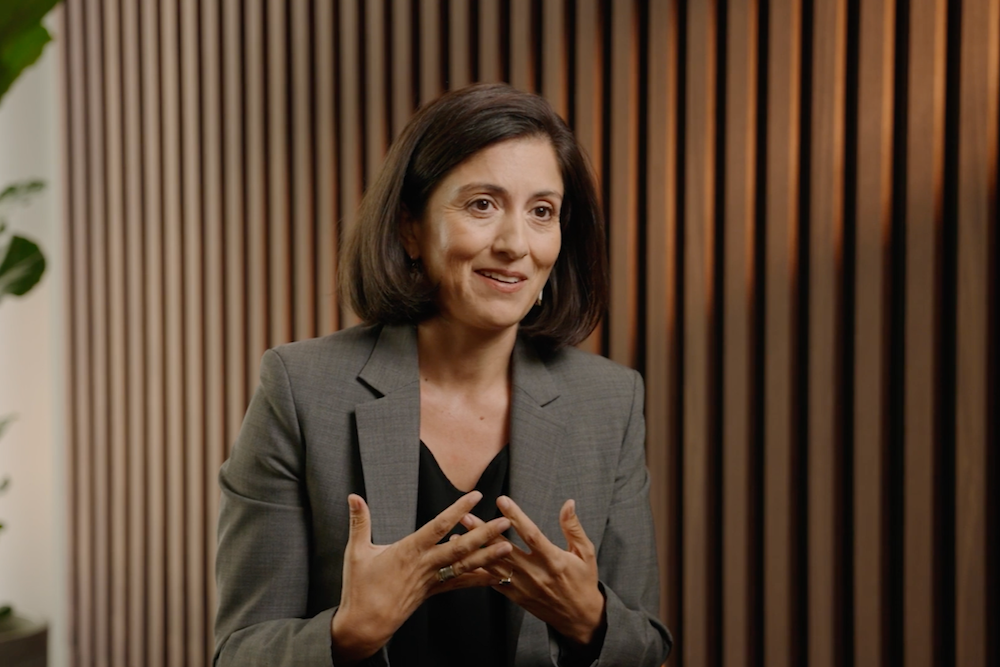
Watch Professor Mendoza's Featured Insights video
Driving along the streets of south Stockton, California, with formerly incarcerated resident Rocky Rontal, Professor Julia Mendoza couldn’t help but be struck by stretches of cracked pavement and scraggly grass – a stark contrast to the manicured sidewalks and spreading ash and oak trees on the town's north side. In prison, Rontal had been classified as a gang member, spending 18 of his 32 years in solitary confinement. As he took Mendoza on a tour of his life, however, she could only see a pattern of abandonment.
Rontal began stealing cars, eventually joining a gang for protection, and inevitably ending up in the prison system. “He was definitely known for being violent in prison, and that’s one truth of Rocky.” Yet Mendoza also witnessed how deeply he cared for his family members and friends. “He had such a heart, I wanted people to see that. Can we hold both those stories in the same frame?”

Now associate professor of law at LMU Loyola Law School (LLS), Mendoza contrasts the story of Rocky and those similarly situated with the harsh language used in the 2005 Supreme Court case Johnson v. California that justified racial segregation in prison on the basis of the supposed extreme violence among incarcerated individuals. "You see the beautiful work that both incarcerated and formerly incarcerated people are doing, and then you read a case such as Johnson and their humanity isn’t acknowledged,” says Mendoza, who wrestles with that dichotomy in her article, “The Language of Mass Incarceration and Organized Abandonment,” published in 2025 by the Stanford Journal of Civil Rights and Civil Liberties.
For more than a decade, Mendoza has worked to help reveal the humanity in disenfranchised communities, embedding herself deeply in affected communities. From California prisons to the urban fringe of East Los Angeles to Allensworth, a town in the Central Valley established a century ago by African Americans, she has aimed to listen to their experience rather than imposing trite solutions from above. “My method is to mobilize my position as a professor to build relationships and tell stories that change the narrative,” she says, “asking how we can all come together to create systems and infrastructure that actually listen to what people need.”
Mendoza brings students in her Criminal Law and other classes along for the ride. “I have seen again and again that the law can create essentially a backbone for us to create the infrastructure, the communities, the systems, and the possibilities for us to thrive,” she says. “I have so many students who at times feel disillusioned with the law. And my response is: ‘Dig into that disillusionment. By learning about the law, you can actually peel back the layers of your disillusionment and find new ways of being in relationship with people, new ways of helping people, new ways of experiencing joy as a community alongside other people.’”
A Unique Journey
Mendoza was motivated early on by a deep sense of family history, stretching back to her great-grandparents who fought in the Mexican Revolution for 10 years before immigrating to the United States. “Understanding the conditions my ancestors had to go through to survive gave me a sense of duty to alleviate similar conditions people live in.” Yet it wasn’t until college at UC Santa Cruz, when she took a class on the prison system with political activist Angela Davis, that she realized the systemic racism that underlies American society. “It broke open my world,” says Mendoza, who earned her degree in American Studies, merging the disciplines of history, sociology, and anthropology. Even as she went on to earn a law degree at UC Davis — practicing at immigration and civil rights clinics — she continued to integrate the social sciences. She went on to earn a master’s degree in human rights from Columbia University in 2010 and a master’s degree and doctorate in American Studies from New York University in 2021.
“Understanding the conditions my ancestors had to go through to survive gave me a sense of duty to alleviate similar conditions people live in.”
Mendoza’s work combines archival research, community-based ethnography, and legal rigor. “My method is always trying to figure out how I develop meaningful relationships with community members based in honesty and integrity and care,” she says, “and from that space develop scholarship that ultimately makes them feel seen and heard.” She cites a seminal experience she had as a Racial Justice Project legal fellow with the ACLU of Northern California, in which she understood the power of community relationships within legal advocacy: “I saw the way to create substantive change was to build the infrastructure within the community through fostering relationships, so when I leave as a legal advocate, they not only maintain change but also continue to build.”
She has applied the same focus on a work-in-progress examining police violence on the urban fringes of U.S. cities. It came out of interviews with community members in unincorporated areas of East L.A. under the jurisdiction of the L.A. County Sheriff’s Department. “So many people had stories of experiencing violence at the hands of police,” she says, and yet the means of redress focused on complaints to a civilian commission were woefully ineffective. Mendoza has since expanded her focus to unincorporated areas on the fringes of other cities. As she looked deeper, she realized that the same areas are also subject to environmental injustice in the form of toxic industries situated on the urban fringes, further compounding the harms and stress already suffered from police violence and making it harder to mount resistance.
The Power of Story
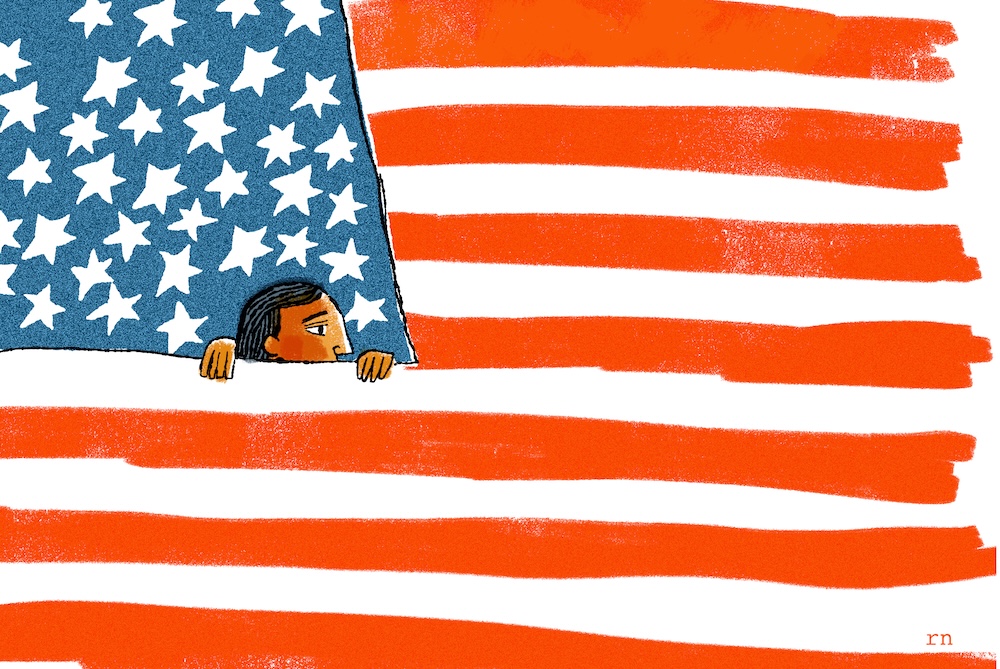
In the midst of conducting research about policing in the urban fringe, Mendoza was confronted by the L.A. Immigration and Customs Enforcement raids in June 2025, with reports of masked men in unmarked black uniforms raiding car washes and parking lots to sweep up people believed to be immigrants and whisking them away into vans. “It was definitely a moment when I officially realized fascism is here.” The violence sparked memories of Mendoza’s own grandmother, who was deported to Mexico as a child despite being an American citizen and then spent the remainder of her life recovering from that pain.
Motivated to do something, Medoza discovered the Community Self Defense Coalition, a grassroots organization mobilized to support the legal rights of immigrants under attack. Moved by their work, Mendoza began conducting an ethnography of the organizers protecting immigrant communities. “By legally exercising their rights together — such as the right to speech and assembly — the organizers protect people whose own rights are formally recognized but practically precarious under the conditions created by ICE.”
She also has begun visiting people detained in the Adelanto detention facility. One woman reminded Mendoza of her grandmother. “She had so much pride working at this car wash and having friends and community.” Yet one day, the sky suddenly was filled with drones operated by ICE. The woman stood her ground to prove she belonged. “Everyone else ran, but she didn’t run because she thought that would make her look guilty.” When Mendoza spoke with her, the woman didn’t even know the status of her case.
For Mendoza, scholarship starts with trust: She turns what she learns into work that helps communities feel seen and heard. The results are personal and concrete, and they begin with a simple chat.
“I just sit in conversation, asking them how their day is going, and they tell me their stories,” she says. “Knowing you are not alone can be the first step in healing your trauma.” Then there are stories of community members looking out for each other when the legal system won’t. One that stuck with her is that of an 8-year-old boy who stood in front of his mother with a know-your-rights card from the Community Self Defense Coalition, refusing to open the door to an ICE officer lacking a warrant. “As a result, everyone was able to remain at home with their loved ones that night,” Mendoza says. “It’s work like that that inspires me in the power of community.”
In the wave of violence and harsh conditions imposed on immigrants, we are seeing both something unprecedented in American history and a pattern of stripping people of dignity that is all too familiar. “It needs to be illuminated so we as a larger society realize what’s happening,” says Mendoza. Until then, she will continue to bear witness, collect stories, and shine a light on our common humanity in even the most afflicted communities.
Michael Blanding is a Boston-based investigative journalist whose work has appeared in The New York Times, WIRED, Smithsonian, Slate, The Nation, The Boston Globe Magazine, and Boston. His newest book, "The Gospel According to Hobby Lobby: Inside a Billionaire Family’s Quest to Craft a Christian Nation," was published by PublicAffairs in July.