Three LMU Loyola Law School alumni share their perspectives on voter participation, representation, and the importance of an informed electorate ahead of the midterm elections.
By Diane Krieger
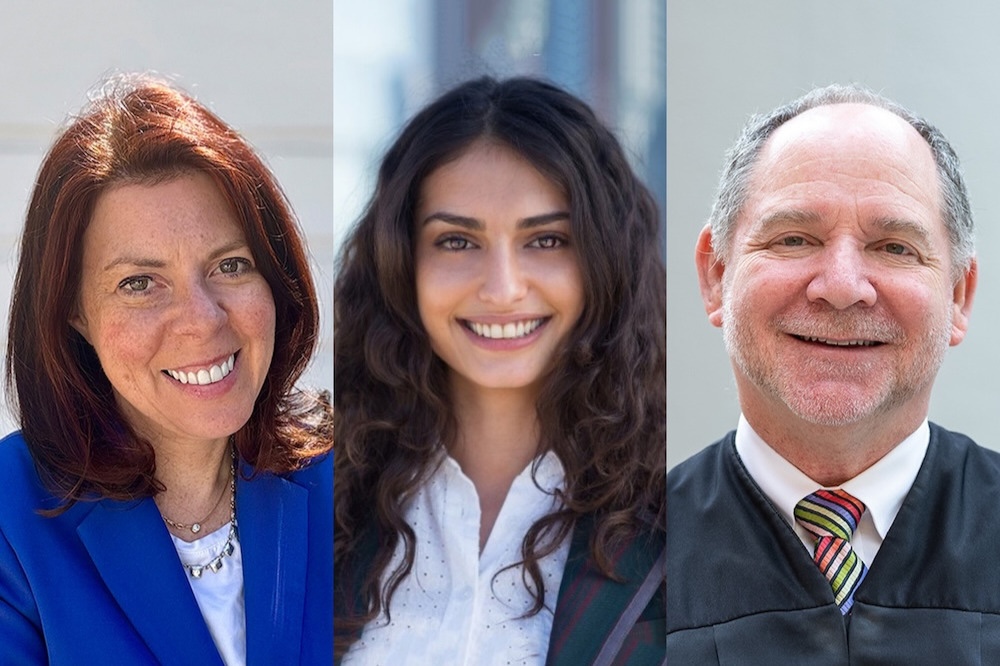
Sara Rohani ’20 is a voting rights litigator with the NAACP Legal Defense Fund. She litigates voting rights cases nationwide at the trial and appellate levels, including before the U.S. Supreme Court. Jessica Levinson ’05 is a clinical law professor at LMU Loyola Law School (LLS), specializing in election law, constitutional law, and laws governing the political process. Not only does she teach LLS students, but Levinson also educates journalists — watchdogs who as our fourth estate are charged with holding those in power accountable — as director of the LLS’ Journalist Law School and reaches the broader American electorate as a CBS News legal analyst, MS NOW columnist, and legal analyst for NPR family station KCRW-FM. Judge D. Zeke Zeidler ’91 sits on the Los Angeles County Superior Court. As a judicial educator, he regularly leads training sessions for the judicial branch, including around implicit bias and LGBTQ+ issues.
What is the relationship between law and democracy?
Sara Rohani: Law is the framework of democracy, but it has never been neutral about who gets to participate. The same legal system that has promised equal citizenship to all has also been used to deny the vote, and it is the people enforcing the laws that push it back toward inclusion. Law is necessary to democracy but never sufficient, and whether it widens or narrows the electorate depends on who wields it.
Judge Zeke Zeidler: To me, it’s a contract with everyone in this country that certain rules will be abided by, that there is elected representative government, and that there’s also a justice system independent of and working on the same rules for everyone on a level playing field, without bias or favoritism.
Jessica Levinson: Law is the set of norms under which we live, and the idea that certain behaviors — transgressions from those norms — should be punished. Democracy is our system of government, though we don’t live within a true democracy. It’s the promise that those who are making the laws are doing so to represent us, as opposed to their interests alone. The promise of democracy is the idea of decentralized power to protect us all.
Why is it so important that people on the margins be represented in elections and elsewhere in American civic life?
Judge Zeke Zeidler: Being on the margins means you have an experience that other people don’t necessarily know about. I once did a training on same-sex weddings with the American Judges Association and the Illinois Judges Association. For the icebreaker, I had the married judges do a show of hands. I asked: “When is your anniversary?” Everyone in opposite-sex marriages had one anniversary. But a lesbian judge and the three of us on the panel had two or three anniversaries. We didn't have the luxury of measuring from marriage as the milestone. The room suddenly lit up. Everyone understood the difference. That’s an example of something that happens for every marginalized group. There are parts of your experience that others don’t see.
Jessica Levinson: The whole idea behind our system is that we protect people from the tyranny of the majority. We have anti-majoritarian institutions because we all understand that without checks, the majority will sometimes run over the rights of a minority. On a policy basis, every study indicates that if you have people with a diversity of experiences and perspectives making decisions, you generally get better outcomes in every space, be it business, politics, government or academia.
Sara Rohani: I am on the margins. I'm a hyphenate — a first-generation American. It sounds very corny, but my first real recognition of being an American was when my parents took me to our neighborhood polling place. I watched their faces light up as they went through. Seeing them voting and knowing that their vote would be counted clearly had an impact on me because voting rights is what I've decided to spend my career advancing.
Everything since then has pushed me to recognize that the promise of equality under law has always been bigger than the actual practice. The Declaration of Independence said that all men are created equal, while millions of men were enslaved. It took the Civil War and then the Reconstruction Amendments to write equal citizenship into the Constitution. For almost a century, those amendments were just words on paper. The promise was delivered with the passage of the Voting Rights Act. That’s the closest we’ve come to realizing that America is supposed to be a multiracial democracy. Since then, I think we’ve fallen short of recognizing that this democracy is supposed to function for everyone, marginalized or otherwise.
What’s the proper role of education in advancing democracy? Should we be starting in grade school?
Jessica Levinson: Absolutely. Starting voter education in college is too late in the game. You have to start much earlier. Sara talked about going to the polling place with her parents. I remember going over the voter pamphlet with my grandparents, who were both immigrants. This started when I was 7 or 8. We would sit down together and talk about it.
So, what’s the role of education? To provide voters with the information necessary to make their own judgments, depending on their own philosophy or political ideology.
Unfortunately, we have a crisis of education. I speak to people outside law school, to reporters who cover elections, to educated, accomplished people, and there is so much misunderstanding of how our government functions and how our elections work. People are coming to me genuinely asking for help. Ballots are long this year, and people are struggling to figure out what the measures mean.
We also have a crisis of disinformation and misinformation. Our First Amendment protects a lot of false speech, and I personally agree with that principle. But the result is that there are a lot of lies about candidates, ballot measures, and our voting systems.
In an ideal world, you don’t need somebody like me to understand the ballot. Everybody should be able to evaluate for themselves. The idea of a representative democracy is built on the presumption of an educated electorate. I think we’ve failed in a number of respects on that promise.
Sara Rohani: As a voting rights litigator, I feel it’s a cop-out to say it’s incumbent on the voter to be informed. I think the issue should be framed as: What are the greatest challenges facing democracy in our institutions? And the biggest challenge, I think, is legitimacy. Whether the voters and the people believe that courts are applying neutral rules or just reaching results that they wanted all along. Louisiana v. Callais was a racial gerrymandering case, but when the court set the case for re-argument it reframed the litigation around the constitutionality of Section 2 of the VRA itself, something that was never litigated at the lower court level. And unfortunately, that is how the Voting Rights Act died. It wasn’t in a fair fight — in the way our system is designed to work. It was in a case engineered to produce a predetermined result. It’s not that the voters are misunderstanding. It’s that the systems are failing. That’s where I would focus.
What about elected judges? Can the American voter be expected to make these choices?
Judge Zeke Zeidler: I don’t believe we should be electing judges, and I’m an elected judge. It isn’t just because the electorate does not have sufficient information to evaluate each candidate's qualifications. There's a bigger reason not to have elected judges: We always want judges to be fair, regardless of public clamor, not beholden to the electorate when they’re ruling on a controversial issue. We don’t want judges to have, in the back of their minds, fear of losing their seat if they make an unpopular decision. That has happened many times.
I don’t presume that the appointment process is any better. Depending on how much politicization there is, it could be just as bad. In California, we happen to have a really great process for evaluating judges and justices before they are appointed.
If you could make one big change in our elections, what would it be?
Judge Zeke Zeidler: I have one for Los Angeles County: free candidate statements in the voter pamphlet. The cost to have a voter ballot statement is exorbitant, and most candidates can’t afford it. When I first ran 20 years ago for judge, countywide it cost $65,000. And there’s no other way for candidates to reach voters with a concise explanation of who they are and what they stand for.
Jessca Levinson: I’ll pick an easy one: federal holidays for federal elections. It could dramatically increase participation. This is a day voters don’t otherwise have to go to work. The government does its part, and the voters do their part. I’m not calling for mandatory voting. If you really don’t want to vote, you really shouldn’t.
Sara Rohani: I’m a litigator. I am a litigator by trade, and not a policy expert, but fortunately at LDF, I’m surrounded by brilliant colleagues who are advancing state voting rights acts and building protections at the state level. The federal Voting Rights Act and federal legislation were never intended to be the ceiling. They were always a floor. My colleagues and partners across the country have successfully worked to enact even greater voter protections in states like Maryland, New York, Delaware, and very recently expanded the California State Voting Rights Act’s protections. I’m very jealous that I’m not in California to be able to celebrate with you all.
Diane Krieger, a frequent contributor to LMU Magazine, is a Los Angeles-based freelance writer whose work has appeared in publications at USC, Tufts University, Johns Hopkins University, Caltech, and The Idaho Statesman, where she was the resident philharmonic and theater critic.