Constitution Day Lecture Examines Backdoor Attacks on First Amendment
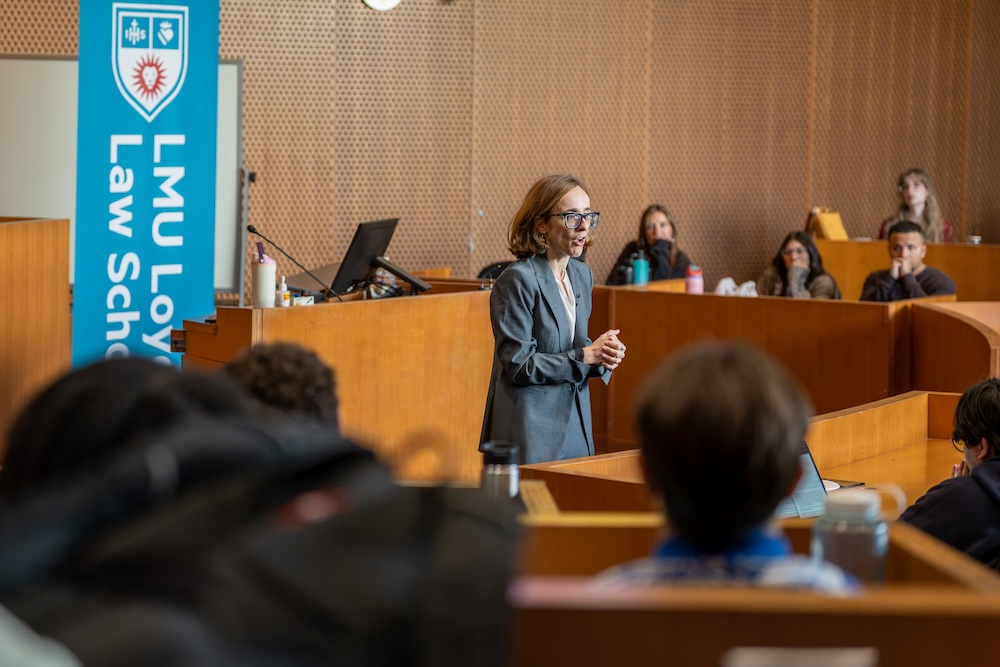
The First Amendment is under attack – but not the way many of us traditionally think. Professor Simona Grossi, Theodore A. Bruinsma Fellow, discussed the Trump administration’s new strategy to punish disfavored views, which she’s coined “expressive governance,” at LMU Loyola Law School’s Constitution Day lecture on Sept. 17, 2026.
The conversation brought to life theories she has developed in her scholarship – including “Policing Expressive Governance: A Framework for Judicial Review of Executive Viewpoint Retaliation” – and a string of related op-eds in the Los Angeles Times, Bloomberg Law, and the Daily Journal. They are a natural extension of Grossi’s scholarly interest in constitutional law’s intersection with civil procedure and civil rights. Other work has focused on both procedural due process in the First Amendment in looking at equal protection and affirmative action analysis.
Dean Brietta Clark introduced Grossi to a packed Robinson Courtroom as Constitution Day’s “guide” through current displays of executive power and their interplay with the First Amendment.
“We want to use today to invite you to reflect on the principle of rights and freedoms that underlie the Constitution, the foundation of our democracy,” Clark said. “We invite you to consider how well or not we are delivering on the promises, the rights, and responsibilities that we made to each other through this document.”
Grossi went on to define the term she has coined: expressive governance, a new tactic by the Trump administration that constitutes an attack on the First Amendment but not through outright censorship. Instead, the executive branch has been revoking contracts, funding, or access from companies and other entities that assert opinions that the government does not agree with.
“The government is governing through apparently neutral administrative tools that have in fact the effect of limiting speech,” Grossi said.
The most powerful, recent example of this practice is the case of Anthropic v. Department of War, in which the federal government labeled Anthropic a “supply-chain risk” after it refused to allow the government to use its AI models for mass surveillance of Americans and lethal automatic weapons, which are against its own policies.
“The problem in that case is that the government did not have statutory grounds to label the company a supply-chain risk. And yet it did that,” Grossi said. “It did that because it disfavored the message – the speech that the company wanted to express.”
Ultimately, the court ruled in favor of Anthropic, citing the government’s lack of statutory basis or legitimate justification for blacklisting the company.
Grossi described the framework she envisions for how courts can respond to cases like Anthropic: examining whether Congress authorized the federal government to take such action; examining whether there is a pattern of discrimination; and shifting the burden of justification to the government, not the company.
For Grossi, cases like Anthropic are not just about one company – they’re about protecting democracy itself. She hopes students are not discouraged by what’s happening but inspired by the judges whose rulings are protecting Americans’ rights to free speech.
“In fact, as New York Times v. Solomon said, the First Amendment is truly at the center of our democracy,” Grossi said. “So to protect our democracy, we need to protect the First Amendment.”
Held each year on Sept. 17 to commemorate its 1787 signing, LLS Constitution Day lectures have taken a variety of approaches to examining the document’s impact. The 2025 lecture was delivered by Professor Justin Levitt, Gerald T. McLaughlin Fellow.