Summer Job Diaries: Hybrid JD Evening Student Gains New Perspective on Benefits of Judicial Clerkship
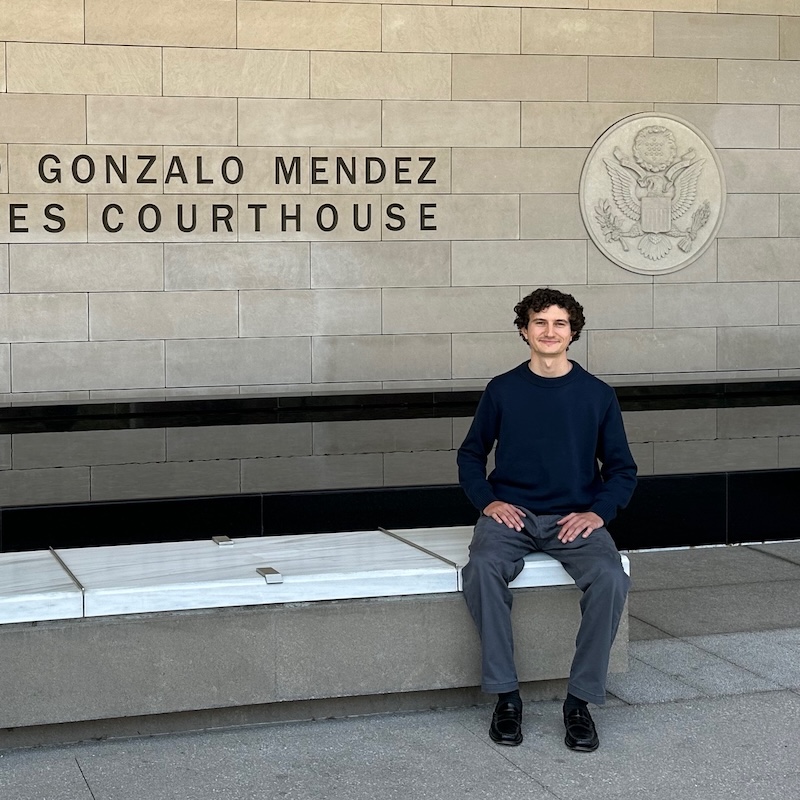
Ryan Livigni ’28, clinical administrative coordinator at the Loyola Social Justice Law Clinic by day and Hybrid JD Evening student by night, spent his summer as an extern for Judge Wesley Hsu, U.S. District Court for the Central District of California. He’s improved his writing skills by drafting a motion to dismiss and practiced his statutory interpretation skills by interpreting an amendment to a California statute. The experience has him considering how a post-bar clerkship could benefit his public interest career goals.
How did you land your summer job?
Last fall I met with my career counselor and the Field Placements Department and determined that I wanted to pursue a judicial externship. In November and December I applied to several judges’ chambers and was lucky to be asked to interview with Judge Wesley Hsu in mid-January 2026. A few days later I was offered the summer externship.
What is the most interesting part of your job?
I’ve had the opportunity to observe hearings in front of Judge Hsu. It’s been really interesting to witness different argument styles and see firsthand Judge Hsu’s and the clerk’s discussions about which arguments they find most persuasive.
What has been your most challenging assignment thus far?
I have been working on a draft of an order on a motion to dismiss in a breach of contract case. The case involves different claims for fraudulent misrepresentation and violation of unfair competition laws. Many of the issues are new to me and require in-depth legal research into a large body of cases.
What new legal skill have you acquired during your summer job?
Working on the motion to dismiss has required me to analyze other attorneys’ writing and has helped me start to develop a discerning eye for good and bad legal arguments. Seeing other attorneys’ writing has also helped me improve my own writing, which is one of my primary goals this summer. I’ve had the opportunity to submit my writing to Judge Hsu’s clerks for critique, which has helped me make my writing clearer and more organized.
What legal knowledge have you been able to display?
A portion of my work for Judge Hsu has involved statutory interpretation, a skill I started to develop in Professor Justin Levitt’s “Legislation and Regulation” class last fall. I had the opportunity to put this knowledge to the test when I was tasked with determining whether the California legislature intended an amendment to a statute to apply retroactively. Even though the specific issue was brand new to me, I felt like I had a good footing because I was able to apply tools of interpretation I learned with Professor Levitt.
How has Loyola helped you map your career path?
After law school I’m hoping to pursue a legal career in public interest, although I’m not yet sure what exact practice I’d like to move into. Working in Judge Hsu’s chambers has shown me the value of clerking with a judge, and I’m now considering whether I’d like to pursue a post-bar clerkship. The Career Development Office has given me great resources to pursue that goal and has helped me see how a clerkship plays into my larger public interest trajectory.