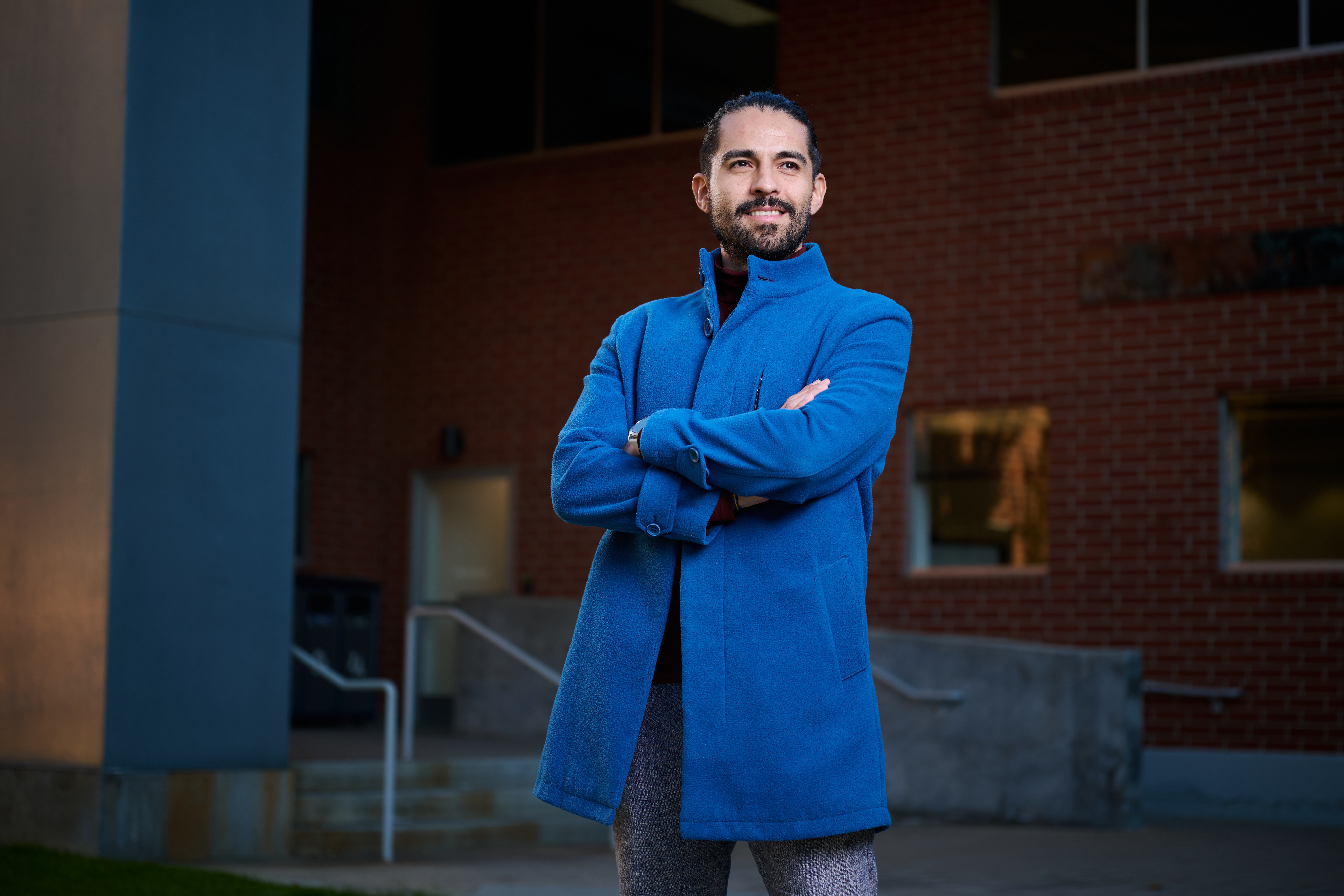
Eduardo Osornio Garcia was recently appointed director of the Binational Migrant Advocacy Project (BMAP), a partnership between the Loyola Immigrant Justice Clinic (LIJC) and ITESO, Universidad Jesuita de Guadalajara.
With more than a decade of experience leading humanitarian response, advancing human rights, and mentoring the next generation of advocates, Osornio Garcia has built a career grounded in the realities of migration and legal protection. At the heart of that work is a simple, personal conviction: “Social justice is the purest nature of being a lawyer.”
Osornio Garcia earned his law degree from the Instituto Tecnológico Autónomo de México (ITAM) and later completed a master’s degree in State and Society at the Universidade Federal do Sul da Bahia in Brazil, where he was selected as an Organization of American States (OAS) scholarship recipient after winning a competitive research proposal. Fluent in Spanish, English, and Portuguese, he brings a global and multilingual perspective to his work with migrant and refugee communities — a perspective shaped by both scholarship and lived experience across borders.
That cross-border experience has defined the heart of his professional life. As programs director at HIAS Mexico, Osornio Garcia led humanitarian operations across 14 locations, coordinating more than 100 staff members and volunteers. Under his leadership, teams implemented large-scale, multi-sector responses funded by international partners. From 2020 to 2025, he worked closely with UNHCR and UNICEF to provide services to forcibly displaced people throughout Mexico.
Across roles with organizations including the International Organization for Migration (OIM), the Jesuit Refugee Service, Asylum Access Mexico, and the Mexican Commission for the Defense and Promotion of Human Rights, Osornio Garcia focused on expanding access to protections for vulnerable populations. The work, he notes, often unfolds amid rapidly shifting immigration policies and limited infrastructure.
“One of the biggest challenges is the lack of protection mechanisms for vulnerable, displaced populations,” he said. “They have many needs, and there are only a few services available. That’s what makes this work so important. Sometimes we are the last option — a unique service.”
Alongside his humanitarian leadership, Osornio Garcia has remained deeply committed to legal education. Before joining BMAP, he served as a professor of international public law at ITAM and consulted for their Refugee Aid Clinic, coordinating research and academic publications on migration and refugee law. He is the author of multiple scholarly works on migration, detention conditions, and the principle of non-refoulement — sholarship that bridges academic inquiry with frontline realities.
At BMAP, Osornio Garcia is eager to connect theory with practice and inspire students to engage in migration advocacy. “Academics need to analyze immigration policies and speak about what is happening,” he said. “Schools have a responsibility to get involved in migration because it is one branch of fighting for social justice. We need the new generation of students to be involved to work with migrant communities and advocate for human rights.”
For Osornio Garcia, joining BMAP is more than a professional milestone; it is a continuation of a lifelong commitment to justice. The clinic’s binational structure, connecting students and advocates across borders, reflects the cross-border work that has long been woven into his career. “It’s a big responsibility,” he said. “But it’s also an amazing opportunity to help others and work with students to find options and solutions for migrants.”
Through his leadership, Osornio Garcia hopes to partner with students to translate legal training into meaningful impact — to transform lives and to help families gain the stability, security, and dignity they deserve.
About the Loyola Immigrant Justice Clinic
Part of the Loyola Social Justice Law Clinic, the Loyola Immigrant Justice Clinic (LIJC) is a community-based collaboration of LMU Loyola Law School, Loyola Marymount University, Homeboy Industries Inc., and Dolores Mission Church. LIJC’s mission is to advance the rights of the immigrant population in East Los Angeles through direct legal services, education, and community empowerment while teaching law students effective immigrants’ rights lawyering skills in a real-world setting. LIJC focuses on providing representation to individuals who are unable to obtain immigration legal services elsewhere with an emphasis on immigrants with certain immigration and criminal complications who reside in the East Los Angeles area. It is the home to the Binational Migrant Advocacy Project, a cross-border collaboration with ITESO, Universidad Jesuita de Guadalajara, that is the first of its kind at a U.S. law school.