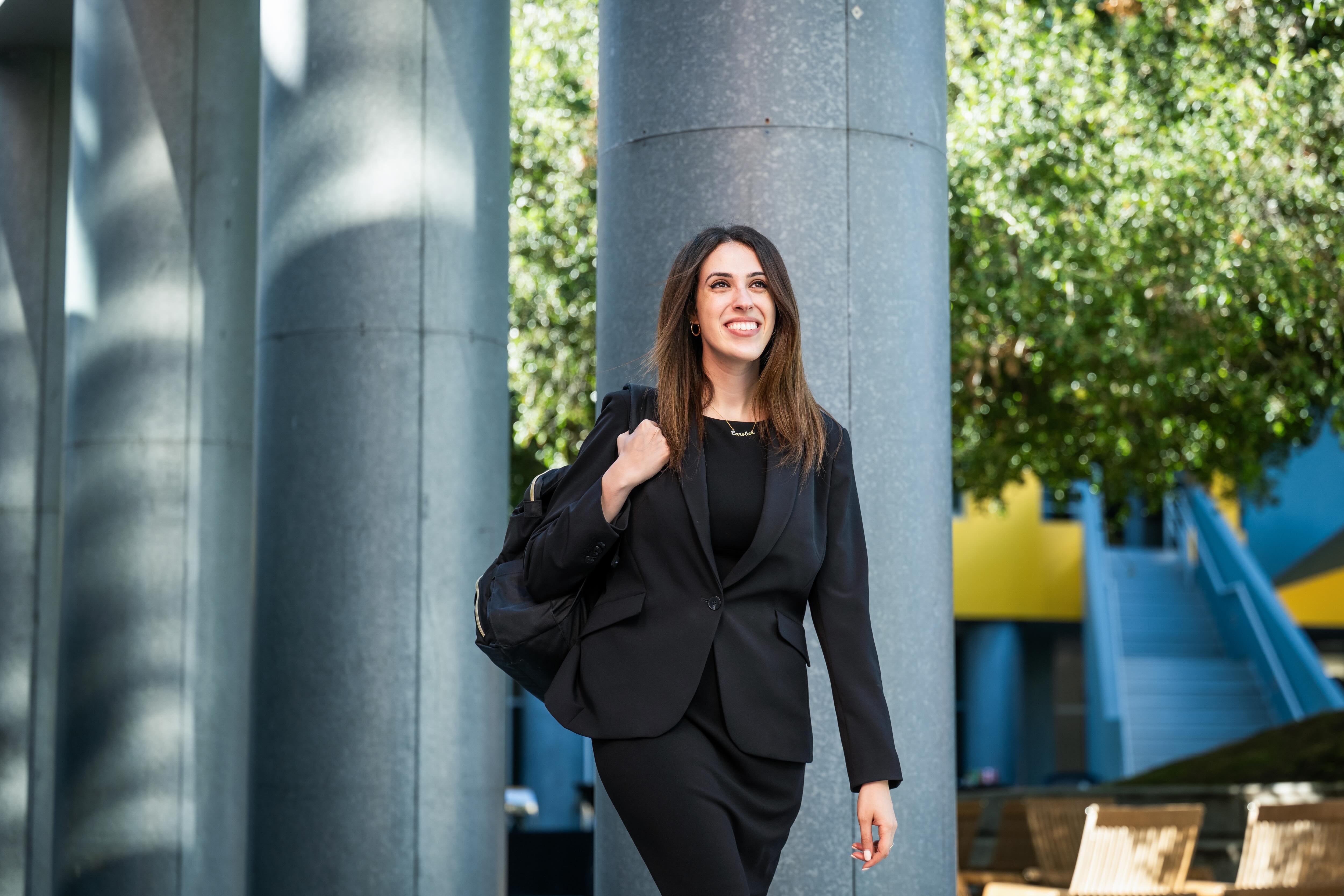
Caroleen Bitar ’26 Finds a Broader Path Through Transactional Law

Caroleen Bitar ’26 initially imagined her future in medicine, not law.
After earning a B.S. in Biology and a B.A. in Psychology, Bitar worked in several healthcare settings, including a nursing home and a Los Angeles surgical practice, where she gained firsthand insight into patient care and the operations of medical organizations.
At the surgical practice, she also witnessed the complex issues that can arise at the intersection of health care and law. Helping the office navigate a legal case gave her an early glimpse into how the two fields converge.
That experience redirected her toward law school, though her interest in health care never disappeared. At LMU Loyola Law School, it became one thread in a growing set of professional interests that she continued to explore through hands-on learning.
Finding a Path Through Experiential Learning
At Loyola, Bitar used experiences inside and outside the classroom to explore her professional interests, strengthen her advocacy skills and help build community.
Much of her legal education initially centered on litigation, including externships with federal and state judges and client-centered work through Loyola’s Center for Conflict Resolution.
She also helped lead Loyola to a regional championship in the National Moot Court Competition. Her team was named Regional Champion and received the Best Brief award, while Bitar was named Best Oralist in the final round.
Beyond the courtroom, Bitar broadened her interests through the Entertainment Law Review and developed a particular interest in intellectual property as co-president of the Intellectual Property & Cybersecurity Law Society.
Her involvement also reflected a commitment to fostering belonging on campus. As a first-generation Syrian American, she served on the founding board of the Middle Eastern and North African Law Students Association (MENALSA), helping create connection and community.
Across those experiences, Bitar was not only studying law but also shaping the kind of advocate, colleague and attorney she hoped to become.
In her final year, the Transactional Law Clinic gave her an opportunity to bring those developing professional interests into practice.
Practice-Ready Through the Transactional Law Clinic
The Transactional Law Clinic gives students firsthand experience advising individuals and organizations on legal matters related to starting and operating a business through two tracks: corporate and intellectual property.
As part of the clinic’s inaugural cohort, Bitar worked in the intellectual property track, counseling clients and conducting trademark research and legal analysis. She also collaborated with students in the corporate track, seeing how business and intellectual property issues intersect as clients build and protect their ventures.
Through Loyola’s partnership with the U.S. Patent and Trademark Office (USPTO), students gained exposure to the trademark filing process under supervision and strengthened their skills through real-world drafting exercises led by practicing attorneys.
Before joining the clinic, Bitar had largely imagined her future through the lens of litigation.
“Practicing as part of the clinic really broadened my horizons,” she reflected.
She came to see transactional law as a way to help clients protect their work and plan ahead before conflicts arise. Studying licensing also showed her how intellectual property extends across industries, including health care and the life sciences.
A related career trek to San Francisco that spring broadened her perspective further. Alongside more than 20 fellow students, Bitar met Loyola alumni working across transactional law and gained a clearer view of the opportunities available in the field.
“Before the clinic, I had never really considered transactional law,” Bitar said. “But the clinic opened my eyes to those possibilities — and the career trek expanded that view even further by showing me the range of opportunities available in the field.”
Together, the experiences opened new possibilities for how she could use her legal education and connect interests that had once seemed separate.
Building Skills for What Comes Next
The clinic’s practical focus was especially meaningful to Bitar because it moved her beyond theory and into the day-to-day work of legal practice.
“This is the first clinic of its kind on this campus,” Bitar said. “It’s important to have these kinds of experiences in order to apply what we’re learning.”
As a recent graduate, Bitar hopes to continue building experience across litigation and transactional work, with an eye toward opportunities in intellectual property, health law or a space where the two overlap.
Looking back, she sees Loyola’s experiential learning opportunities — and the Transactional Law Clinic in particular — as defining parts of her development. Each experience allowed her to explore a different part of the profession, while the clinic brought those possibilities into clearer focus.
“If I had not done the Transactional Law Clinic, I don’t think I would have seen all of these other pathways,” she said.
For Bitar, experiential learning did more than prepare her for legal practice. It helped her realize that she did not have to choose between her interests. Instead, she could build a career that brings them all together.