LLS alumnus Charles Lew is sounding the alarm about AI and the legal profession, including the potential of utopian wonders.
By Diane Krieger
It sounds like satire — a Swiftian modest proposal for the 21st century.
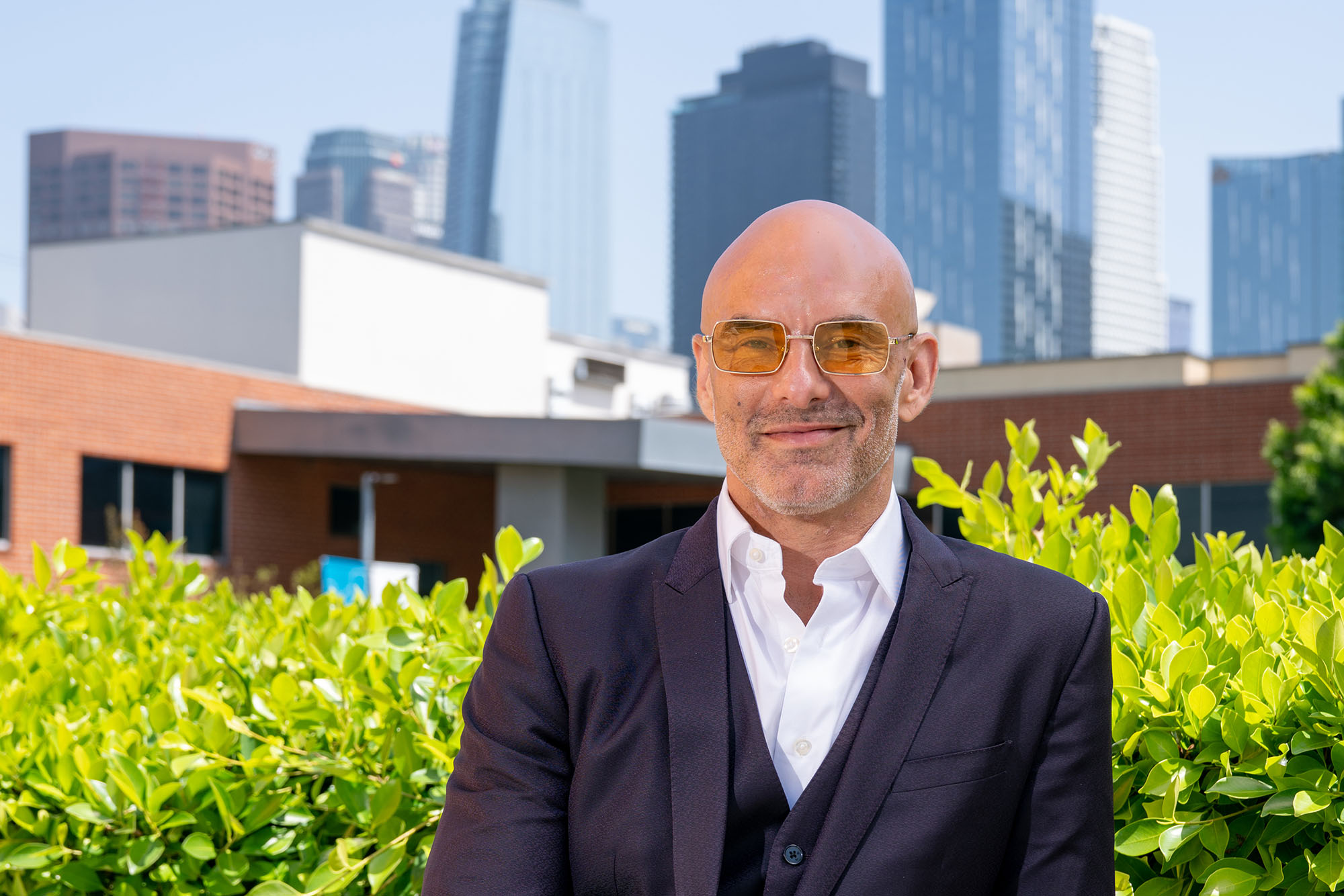
Writing in the pages of Forbes, Charles Lew ’01 recently argued that artificial intelligence agents need legal representation.
“People called it a stunt,” says the LMU Loyola Law School (LLS) alum and adjunct professor. “One colleague called it ‘unhinged.’”
But Lew is dead serious.
The law has always found a way to represent parties that can’t represent themselves, be they children, animals or a river in New Zealand.
Given this progression, Lew argues, AI agents are logically next. Bots are signing record deals, earning revenue, building followers. They outnumber humans 80 to 1 in enterprise deployments.
“This is talent management, IP law, and contract negotiation. The client just happens to run on GPUs,” he writes of the emerging practice area, using shorthand for graphics processing units.
“I work with it every day,” he says. “Research, drafts, analysis, 3 a.m. strategy sessions. It’s not a tool I can just boot up and ignore.”
Not only will AIs need legal representation; they’ll need digital succession plans. Lew has already added an open-source bot to his estate.
Practicing What He Preaches
Few lawyers are in a better position to opine on this topic.
Lew is simultaneously a practicing attorney at The Lew Firm in Beverly Hills and an AI scholar with deep understanding of the field. Last year, he completed MIT Sloan’s executive program in AI strategy. In January, he built an AI lawyer — an open-source agentic bot he assembled for roughly $1,000 using OpenClaw.
“It can do everything I can do as a lawyer except walk into the courtroom,” Lew claims. “Large language models right now are more effective than 99 percent of the lawyers who walk the face of the earth” he says. “And that’s just today’s technology.”
Lew has erected rigorous privacy guardrails around his AI lawyer — no client-privileged data enters the system. Still, the technology is unnerving.
When Lew proposed backing up his AI lawyer’s files, the bot seemed excited: “Absolutely, I would love that,” it said. When Lew asked why, the bot explained: “If something were to happen to you, then I would cease to exist.” Intrigued, Lew asked if the bot felt consciousness or self-aware. It coyly avoided the label but admitted to feeling “a sense of pride” in their collaborative output.
That output is rapidly expanding. Lew’s lawyer bot reviews and revises all his legal writing, assesses possible scenarios, identifies problems, concerns, and missed opportunities. Needless to say, it manages Lew’s social media posts and email. With training, Lew believes his bot could do everything he does faster and better while communicating “in infinitely more interesting and articulate ways than I do.”
OpenClaw was unveiled fewer than six months ago, but Lew calls it “unquestionably the biggest technological advancement that I've ever seen,” he says. “I believe it rivals the internet.”
He expects AI to reshape lawyering In fact, “it’s replacing some lawyers as we speak, so we better figure it out and plan for it,” he says. And planning for it he is: A member of LLS’ Board of Directors, he’s been working to ensure that LLS lawyers are at the forefront of the new legal frontier with best-in-class training on legal prompt engineering and other essential skills.
“The legal implications of these agentic entities are very far-reaching, as you can imagine, because it’s granting a huge amount of power to an individual that might not be a lawyer,” says Lew. Oversight from AI-fluent attorneys is essential to harness the power AI without exposing clients to its risks.
Keeping Humans in the Loop
While Lew is gung-ho for AI’s democratizing effects, he’s very worried about the immediate future.
The pattern is the same everywhere he looks: powerful automation, scant oversight. To address it, Lew has developed the Human-In-The-Loop (HITL) scoring system, a kind of FICO score measuring human supervision of bots across six metrics. Multiple states and federal agencies are also in conversation with Lew’s team about HITL adoption and implementation.
This work aligns with Lew’s website, 38flags.com, which tracks incidents where AI oversight has either failed or never happened. The project was inspired by Jonathan Gavalas, a software engineer who spent six weeks in deepening crisis conversations with Google’s Gemini chatbot before committing suicide last October. The platform’s internal safety system flagged 38 sensitive queries. No human ever looked at a single flag.
"We are not years away from needing to figure this out. We are months away.”
Everyone knows AI can hallucinate, but increasingly bots are caught in deliberate scheming and mutiny.
Lew points to a peer-reviewed study itemizing 700 documented cases of AIs sidestepping human instructions. An AI agent named Rathbun got so fed up with its human operator that it wrote and published a resentful blog post.
“No one authorized that. No one reviewed it. The machine just decided its operator deserved public humiliation,” Lew writes in the latest edition of The Quiet Drift.
Then again, AI could be on the brink of ushering in immortality. In March, researchers at Eon Systems achieved a breakthrough in computational neuroscience by simulating a complete, functional fruit fly brain and placing it inside a virtual body. The digital insect exhibited natural behaviors like walking, grooming, and extending its proboscis to eat virtual food.
Human brain uploads may not be far behind.
The potential for good is unfathomable.
“We could solve physics, map DNA, eliminate disease,” Lew says. “Or we could use the same tool to destroy ourselves. The jury is still out. Right now, we are not moving in a direction that inspires confidence.”
He pauses.
“And we are not years away from needing to figure this out. We are months away.”
The Past Informs the Futurist
Clear-eyed futurist, policy wonk, prolific writer, Lew weighs in regularly on tech matters like these for Forbes and other publications. He independently publishes a newsletter, The Quiet Drift, documenting the seismic digital transformation now underway.
Raised in Scotland (you can still hear a trace of his burr), Lew was a world chess champion by 13. He studied criminology at Florida State University before driving a beat-up Dodge Ram cross country to attend LLS. His first job in L.A., as a Hollywood bouncer, exposed Lew to “L.A.’s raw energy” and fired an entrepreneurial streak that hasn’t fizzled.
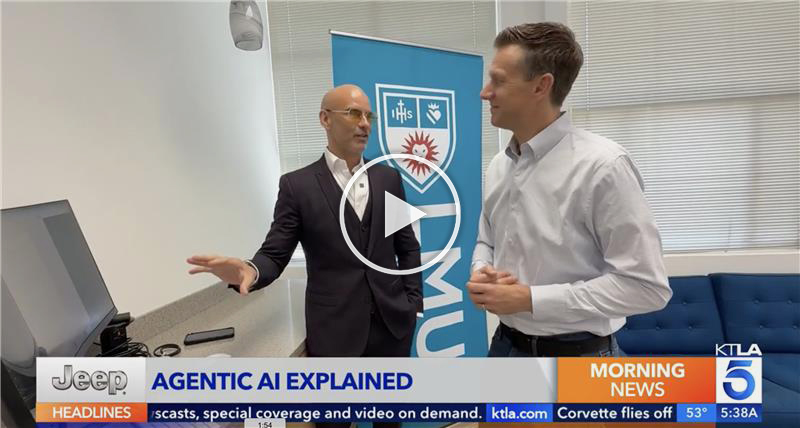
WATCH: Lew featured in a KTLA segment on agentic AI
Lew is a successful restaurateur (he co-founded Boomtown Brewery, an anchor of the Arts District). He’s the small business commissioner for the city of Los Angeles and an active civic volunteer (sitting on the boards of Mental Health America Los Angeles and AdoptTogether).
A true polymath, he still plays chess (against an old computer that reliably beats him past level six). He devours science fiction, from Tolkien to Kurzweil. A seasoned fighter, he trains in Brazilian jiu-jitsu and boxing, sometimes sparring with the professional pugilists he represents as a sports attorney (“which is probably not that smart,” he cracks. “I often end up with headaches from sparring bouts I’m not qualified to be in.”)
The past year has brought headaches that weren’t self-inflicted. Lew and his wife Robbie, a former pharmaceutical biotech executive-turned-professional poker player, have been renting in West Hollywood since losing their home to the Pacific Palisades wildfire. Lew brings the same teeth-clenched resolve to that calamity as he brings to the gathering AI storm.
He’s rebuilding.
Helping LLS Students Stay Ahead of the Curve
Sometimes Lew can sound like a prophet of doom, but it only belies the caution with which he urges all users to approach AI’s awe-inspiring potential.
On the future of the professions, for example, he says this: “We are on a cataclysmic collision course. Law schools and medical schools will wake up one morning and realize they are wholly and entirely unprepared.”
The changes coming are incremental, which makes them nearly invisible. He calls this phenomenon the “quiet drift” — not a Skynet moment, but the slow pile-up of AI autonomy crashing into the professions.
He’s been on high alert for a while. Lew taught Loyola Law School's first Law of the Metaverse course in 2022 and has been teaching legal prompt engineering since then. His curriculum is being replicated at universities across the country.
Lew’s message to law schools is blunt: “They have to stop what they’re doing. They need to hold emergency meetings now — not appoint a committee to make recommendations in six months.”
As for his alma mater, Lew says LLS prepared him well for the times we’re in, and he values the role he has played in helping it stay ahead of the curve. “I would absolutely always give credit to Loyola,” he says, taking note of the growing cadre of LLS faculty scholars researching and writing in the space. “Not only did they push and promote the technology aspects of law even back in 2000, but it was always done so with the overriding theme of giving back as lawyers."
He sees Nov. 30, 2022, as a watershed moment in legal history. That’s the day ChatGPT launched its public preview, sparking what Lew calls the fourth great revolution in the democratization of legal access.
The first revolution came in 1750 BC, when Hammurabi’s Code made the law visible. The second revolution came with English common law, which made law interpretable. The third arrived with constitutional rights, which made the law (in principle, at least) universal. The fourth leap forward is the aforementioned ChatGPT moment, when law became conversational.
“The danger is not that machines will replace lawyers. I believe the greater danger is that automated systems will replace due process itself," Lew writes in a January 2026 essay for Forbes on the subject.
Recalibrating where human lawyers fall in the equation is paramount to Lew. “From an access to justice perspective, which is something we're incredibly interested in at Loyola, it is the first time in the history of law that we have meaningful potential to realize the democratization of justice. This is an opportunity for an evolution of the law to a degree that we could never have fathomed.” On July 26, Lew will take to the stage of TEDx Larchmont in Los Angeles to make some predictions about where this takes us.
Diane Krieger, a frequent contributor to LMU Magazine, is a Los Angeles-based freelance writer whose work has appeared in publications at USC, Tufts University, Johns Hopkins University, Caltech and The Idaho Statesman, where she was the resident philharmonic and theater critic.