By Brian Costello
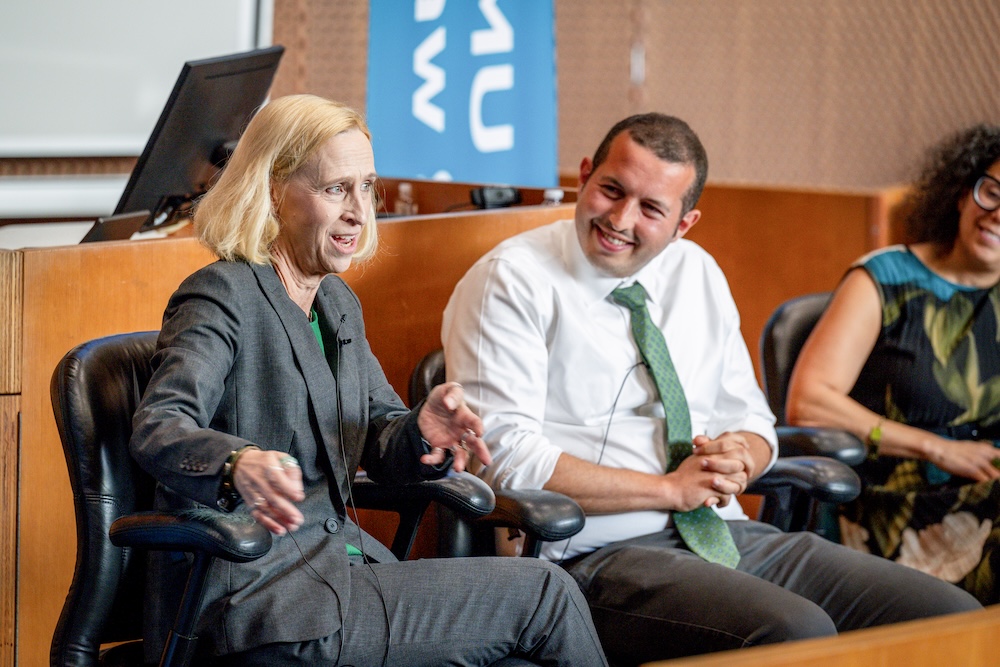
“How many decisions are out there sanctioning lawyers for improper use of generative AI?” asked Professor Yan Slavinskiy during a recent session of the Dean’s Den discussion series hosted by Dean Brietta Clark.
The room of about 100 sat silently for a few seconds. Finally, “12” said one audience member. Then someone blurted, “1,000.” But it was clear this was no easy answer for most of the audience, and Slavinskiy had forbidden answers from students in the “Generative AI in Legal Practice” course he and Professor Rebeca Delfino co-created and launched last year, as they well knew the figure.
“There are 300 sanctions decisions and counting, and these are just the documented ones,” said Slavinskiy, who was a New York City assistant district attorney and judicial law clerk prior to joining the LLS faculty.
The trend, especially with a skyrocketing number of such cases in California, caught his attention. “We are facing this moment where the truth is getting bent – a moment where lawyers are filing briefs with fake cases that are being incorporated into judicial decisions. We're really facing a crisis. But because of how dramatic that all is, what gets lost is the true potential of generative AI,” Slavinskiy said. “I want students graduating here knowing how to use generative AI – knowing when to use it and when not to use it.”
“I want students graduating here knowing how to use generative AI – knowing when to use it and when not to use it.”
He and Delfino set about creating a course focused on both the practical applications and ethical considerations of using generative AI in legal practice. Their course is rife with hands-on exercises where students do everything from compare manually written and AI-generated memos to explore case hypotheticals through Large Language Models (LLMs) to see how their analysis differs from a human’s. Practice guidance includes legal research tips to avoid such AI pitfalls as case hallucination, AI’s fabrication of non-existent cases, and best practices for creating search prompts. The course’s goal: for students to develop the critical skills necessary for integrating generative AI into their legal practice responsibly.
“One thing that is important for us to think about as lawyers is what our role is in society,” said Delfino, a former Big Law attorney who before joining the Loyola faculty was the lead senior appellate attorney for the California Court of Appeal, Second Appellate District. “Lawyers are first responders in any crisis, and some view this as a crisis. But by learning about AI and generative AI, by understanding the benefits, risks and the lack of safeguards around these tools, and learning how to use them, we are better lawyers, effective responders, and informed human beings.”
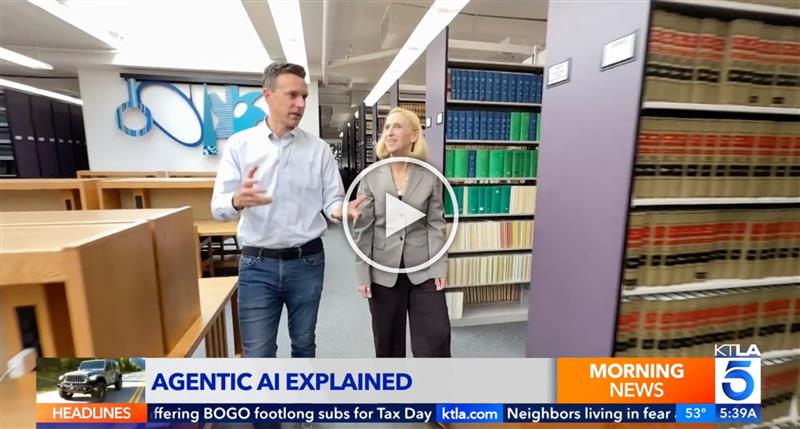
Watch: Delfino featured in a KTLA segment on agentic AI
It is not lost on the professors that teaching at a Jesuit institution, with an emphasis on ethical lawyering, advancing social justice, and training attorneys for others, brings with it a unique perspective and obligation.
“We need to be agents for the good social change and social justice,” said Delfino, who initially became interested in AI via her scholarship around deepfakes – artificial images or videos that swap in the likeness of a person who was not part of the original asset.
In their course, Delfino and Slavinskiy emphasize generative AI as a practice enhancer, not a short-cut. Delfino is quick to point out that in many ways, generative AI will not necessarily make lawyers’ lives easier – in part because of all the checks its ethical use requires. Advice dispensed includes practicing on something low-risk – like planning a vacation – and on subjects students know well so that they can spot errors. The professors also coach students on how to use AI to improve their research, such as using it to create Boolean search terms they can then apply in a legal search database like Westlaw or Lexis-Nexis.
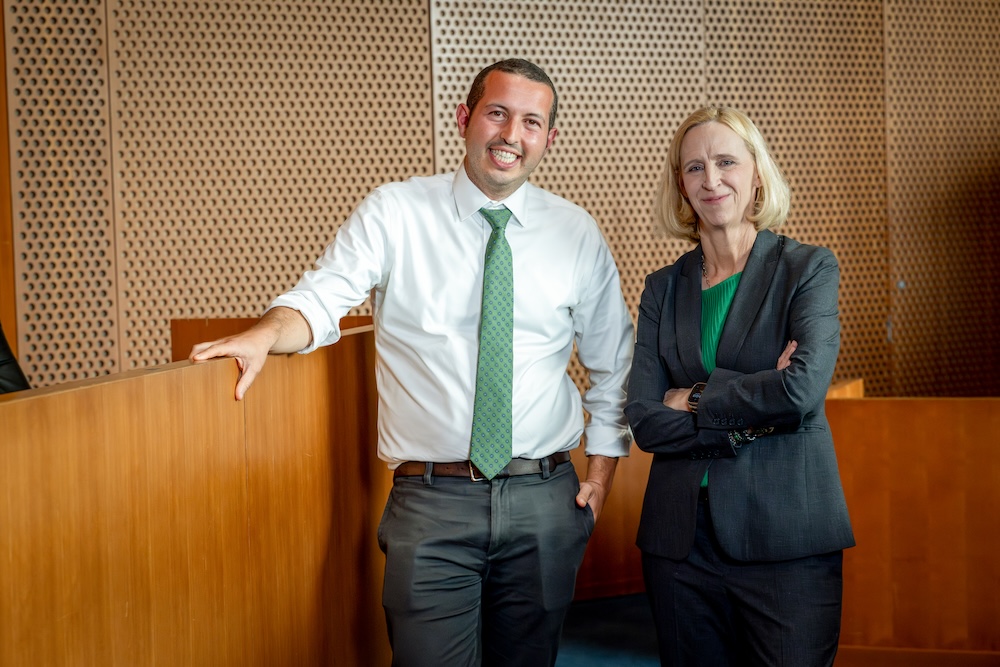
Slavinskiy recognizes the power AI has to bridge language gaps. As a non-native English speaker, he views generative AI as a tool that can put lawyers from a range of backgrounds – some who did not grow up speaking English, did not have lawyers in their family, or experienced a disparate array of quality in early education – on equal footing. He also views it as an efficiency tool, allowing attorneys to focus on creative legal arguments instead of more routine tasks. “That means more time to craft better briefs and better motions and more interesting theories” by reducing administrative burdens, he said.
Slavinskiy thinks new graduates should look at expertise in use of AI as a calling card. “Generative AI is not going to replace lawyers,” Slavinskiy said. “It's going to replace bad lawyers, and it's going to ultimately replace lawyers who refuse to grapple with these tools. So I want folks leaving this law school at least equipped to tell a supervisor, ‘I can't use it for that purpose.’ Or, ‘Actually, I can save five hours by using it for that purpose.’”
Both professors see a lot at stake in this moment but value the chance to be part of a sweeping movement as it hits an inflection point.
“We are living in a moment I analogize to the invention of the printing press — an innovation so transformative that it creates a meaningful divide between what came before and what follows. Generative AI represents this kind of shift: not simply an improvement in existing tools, but a fundamental reordering of how information is produced, disseminated, and understood.” said Delfino.
Brian Costello is director of marketing and communications at LLS, from which he earned his J.D. in 2012. He is a former producer and reporter for CBS News, E.W. Scripps, and Warner Bros. Domestic Television.