Don’t Quote Me
Amid #MeToo Era, ‘Don’t Quote Me’ Panel Addresses Pay Equity in Hollywood
A million and a half dollars. That was the difference between the paychecks received by male star Mark Wahlberg and female star Michelle Williams for reshoots on the film “All the Money in the World.” And that’s a problem, stated panelists at Loyola Law School, Los Angeles’ “Don’t Quote Me: Recent Developments in ‘No Salary History’ Law” event this month, which examined how Hollywood is adapting to a new law preventing employers from relying on prior salary history in establishing pay.
The new law, California Labor Code Section 432.3, prohibits employers from relying upon or seeking a candidate’s salary history in determining an offer of payment. This turned upside down the practice of Hollywood studios, production companies and talent agencies asking prospective employees for their “quote,” or their compensation history.
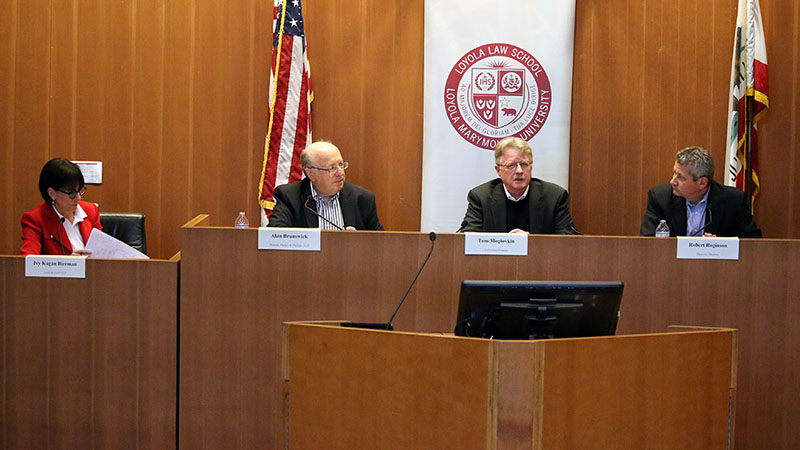
Intended to reduce gender and other pay disparities, the law introduced a host of other questions that were contemplated by the distinguished panel of experts at Loyola Law School’s event: lan Brunswick, Manatt Phelps & Phillips LLP; Tom Moglovkin, senior vice president of Business Affairs, Universal Pictures; and Robert Roginson ’96, partner, Ogletree Deakins and a Loyola alumnus. The panel was moderated by Ivy Kagan Bierman, partner, Loeb & Loeb LLP, and organized by Professor Jay Dougherty, director of Loyola’s Entertainment & Media Law Institute.
Bierman emphasized that the law was created with the best of intentions. “I think we’re going to see less of a range between the compensation for men and women, and more diverse individuals working on products,” she said.
Other panelists say the law’s mission is slowly being accomplished. Brunswick pointed out one positive piece of evidence: Women and minorities have reported an increase in pay during the 2018 spring pilot season.
However, the panelists almost unanimously faulted the vagueness of the law, which went into effect on Jan. 1, 2018, for creating more questions than it answers. Their prediction: lawsuits ahead.
“It’s a horribly drafted law,” said Roginson. “There is no clear standard that’s easy to enforce.”
Moglovkin agreed that the ambiguity of the law led several studios to interpret it very conservatively. “We never ask for a quote,” he said. “We never hint or do anything that could be interpreted that we’re fishing.” Sometimes, he noted, this is to the disadvantage of the job candidate.
The problem production companies’ face, Roginson explained, is properly educating those hiring crew members and production staff to ensure they remain compliant – both above and below the line in production deals. Another challenge: studio employees transitioning to jobs within the same organization or with the same managers who may already know their salary history.
Want to make a difference in the entertainment industry? Learn more about how Loyola alumni are making an impact in entertainment law or apply now.