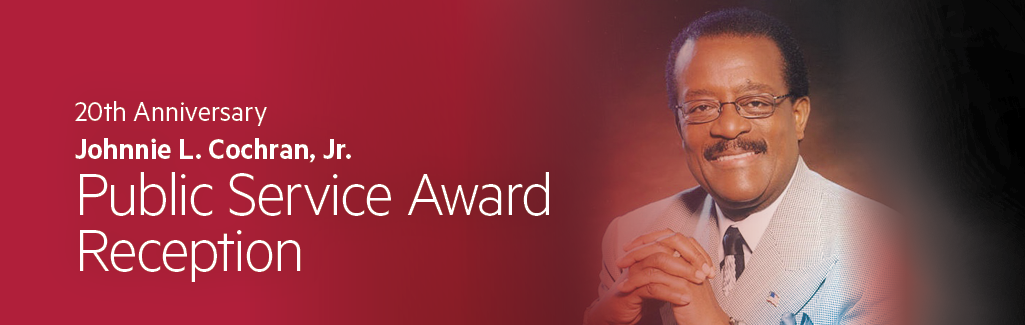
LMU Loyola Law School hosted a two-part event on Oct. 16, 2025, honoring the legacy of the late Johnnie L. Cochran, Jr. ’62. The celebration brought faculty, students, alumni, and community together to mark the 20th Anniversary Johnnie L. Cochran Jr. Public Service Award Reception — and featured a panel on racial justice and an award presentation recognizing Hon. André Birotte Jr. ’91 for his distinguished public service.
Historical Truth and Civil Rights: A Conversation
The evening began with a panel, “Resisting the Whitewashing of American History,” moderated by Professor Gary C. Williams, Johnnie L. Cochran Jr. Chair in Civil Rights. Williams opened by pointing toward nationwide efforts to distort and erase historical truth, noting: “Johnnie Cochran would have vigorously resisted this whitewashing project — and we honor his legacy this evening by presenting [this] panel.”
Panelists included civil rights scholar Robert Chang from UC Irvine School of Law; Chief Counsel Peter Eliasberg from the ACLU of Southern California; Terrence J. Evans ’02, a partner at Duane Morris LLP and president of the California Lawyers Association; and Loyola Law School’s own constitutional law expert Kimberly West-Faulcon.
Each offered insights on protecting civil rights and academic freedom. Evans traced California’s history of silencing nonwhite voices in courtrooms to the moment of today, stating: “We are still in the midst of one of the greatest fights to protect civil rights, diversity, equity, and inclusion that we’ve ever experienced.”
West-Faulcon warned against narratives reframing inclusion as discrimination. “We are being sold a lie — that considering race for purposes of inclusion is racism against white people,” she said. “They are targeting racial inclusion and selling it as racism against white people. I don’t think Americans are as outraged as they should be.”
Eliasberg thoroughly examined the legal complexities of challenging bans on teaching about race, describing them as “morally repugnant,” yet incredibly difficult to address under current First Amendment doctrine.
Chang connected today’s whitewashing to a broader “narrative war,” quoting Bryan Stevenson, founder of the Equal Justice Initiative: “The North won the Civil War, but the South won the narrative war.” Reflecting on his work challenging Arizona’s ban on Mexican American Studies, Chang stressed: “Law is one tool; to really win, you need to win in the political realm.”
Evans closed the panel by urging students and young lawyers to continue the fight for justice. “We are here for you,” he declared. “Fight like hell.”
Recognizing Public Service Excellence: Hon. André Birotte Jr.
The evening continued with a reception honoring U.S. District Judge André Birotte Jr. as the 2025 Johnnie L. Cochran Jr. Public Service Award recipient. Carl E. Douglas, Cochran’s former law partner, opened the program with words capturing the spirit of the gathering: “This evening we reflect on the lives of those who carry forward commitment to justice, to excellence, and to service — the impact that their lives have had. Tonight, we celebrate all that they stand for.”
Brietta Clark, Fritz B. Burns Dean of LMU Loyola Law School, acknowledged the Cochran family in attendance, reflecting on Cochran’s legacy and Loyola’s mission to train “lawyers for others” who center the lives and dreams of those historically marginalized or rendered invisible.
Birotte, upon accepting the award, reflected on his early years with Cochran, and how his mentor’s philosophy continues to guide him. “He didn’t want to be defined just by the famous cases,” Birotte said. “He believed that real justice meant fighting for people who couldn’t afford a voice.”
The program also honored the late Professor Lary Lawrence, Carmen Ramirez, and Lola McAlpin Grant, cherished members of the Loyola Law School family, for their mentorship and leadership.
Carrying the Legacy Forward
Closing the evening, Williams reminded attendees that honoring Cochran means more than remembrance — it requires action. “Cochran’s legacy is one of unrelenting pursuit of justice,” he said. Echoing the panel’s message, Evans encouraged students and young lawyers to “carry the torch,” stay true to their values, and fight tirelessly for justice.