Summer Job Diaries: Trio of 1Ls Extern for Superior Court of Los Angeles County Judge Bryant Yang
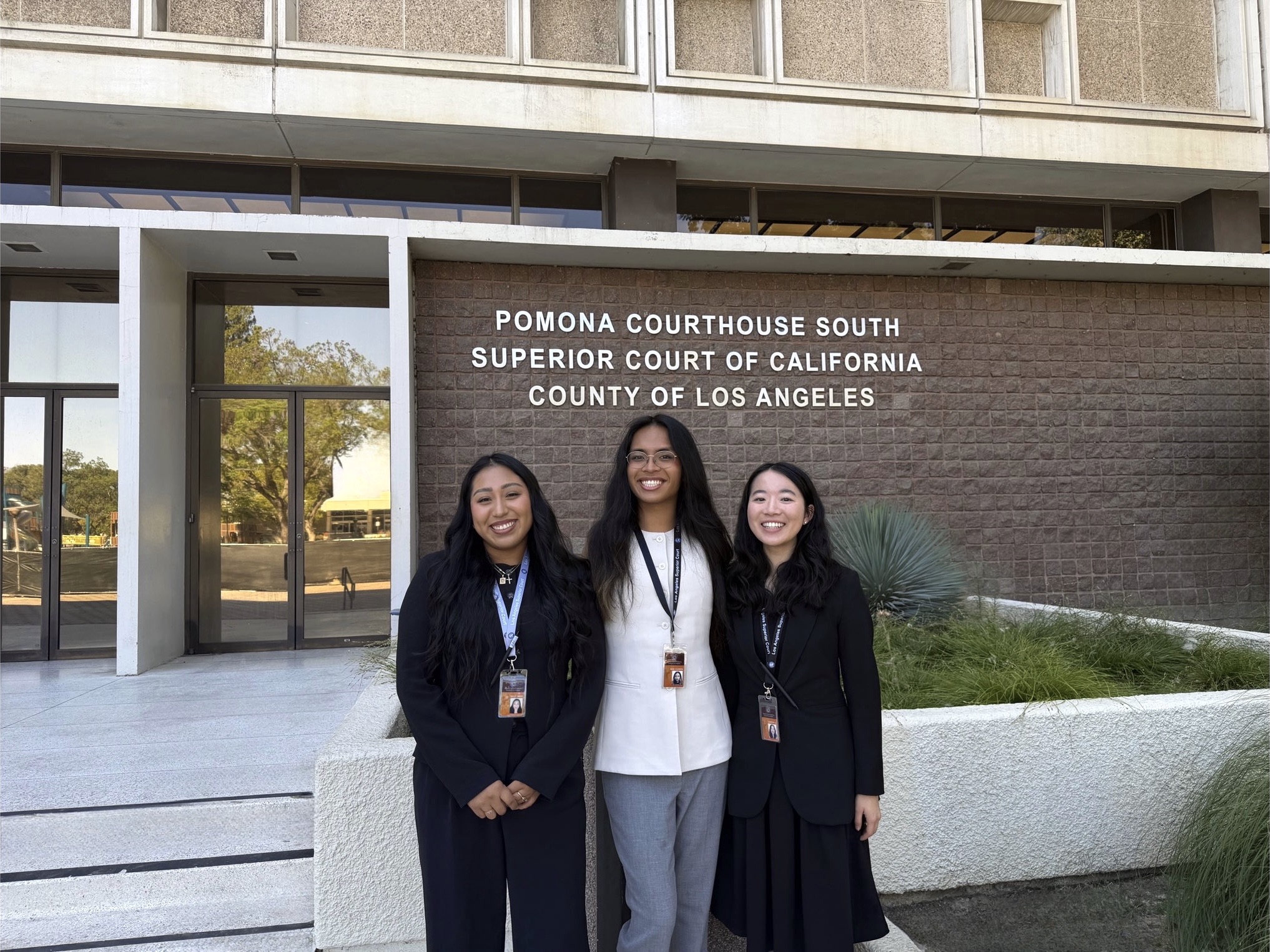
Kelly Simon ’28, Sean Clenista ’28, and Dorothy Li ’28 all have Professor Nadine Tan to thank for connecting them with the opportunity to extern this summer for Judge Bryant Yang, Los Angeles Superior Court. The three first-year students are learning about courtroom proceedings, drafting motions, sifting through case law, and more as they gain experience in litigation and civil procedure.
How did you land your summer job?
Simon: I was scrolling through social media and saw a judicial externship post from the Latina Lawyers Bar Association (LLBA). I initially interviewed with LLBA and had a second interview with Judge Yang. I am grateful to LLBA for sharing this opportunity, and to Professor Tan for her encouragement and interview guidance.
Clenista: When my Legal Research and Writing (LRW) course ended, Professor Tan reached out about a colleague/friend of hers who is newly serving as a supervising judge and was looking for externs. Thanks to Liana Atwell from the Career Development Office (CDO), she sent over my writing sample and resume and connected us together to set up an interview. I practiced my interview with Ariana from the CDO. Immediately after my interview with Judge Yang, he offered me a position.
Li: I landed this job thanks to the help of Professor Tan and the CDO. Assistant Director of Career Development Julie Kim helped with my application materials and interview skills, Professor Tan had referred me for the opportunity, and CDO’s Liana Attwell helped to connect me to Judge Yang. At the time, it was the end of March when my application was shared, and I received my interview and subsequent offer within a week.
What was/is the most interesting part of your job?
Simon: The most interesting part of this judicial externship is the opportunity to see how the judge approaches various legal issues. I have learned so much from just sitting in the courtroom during the morning calendar and jury trial. My favorite part has been getting to ask questions and discuss with the judge and my fellow externs after hearings.
Clenista: Getting to sit in other courts and even go into other judges’ chambers, especially in Family and Criminal Court, I get to see the most interesting cases ever and build a diverse background of legal knowledge. Also, it was really interesting seeing how connected the judges are across different bar associations. This job immensely expanded my network.
Li: The most interesting part of the job is getting a peek at the behind-the-scenes of the judicial system: how decisions are made, the staff who run the court, and observing the judge in chambers. I realize that many attorneys do not get the chance to experience this firsthand.
What has been your most challenging assignment thus far?
Simon: The most challenging assignment thus far has been verifying and updating calculations in a plaintiff’s motion to strike. Not only did Sean and I have to ensure mathematical accuracy, but we also had to ensure that the requested amount was within the enumerated list of California civil procedure rules. The difficult part was reviewing the motion, several supporting declarations, and exhibits to ensure consistency throughout the motion.
Clenista: Same as Kelly!
Li: Similar to Kelly and Sean, the most complicated assignment was working on a tentative motion to strike along with a demurrer — but primarily with looking through the case law. Sifting and seeing whether there was relevant case law took some time, and it made me appreciate the work that research attorneys and law clerks do for judges.
What new legal skills have you acquired during your summer job?
Simon: Being an extern has provided me with the opportunity to not only observe different hearings in civil, criminal, and family law matters, but has also allowed me to practice my legal writing and research skills. I have been exposed to court documents and procedures that were discussed during my civil procedure class.
Clenista: This job has really helped me form legal opinions. Compared to just reading cases and majority opinions in 1L classes, being an extern puts you directly into the case. Understanding procedural errors, what an unsupported argument looks like, and courtroom professionalism are all new legal skills that I have begun learning.
Li: I believe this experience improved my legal writing skills substantially, since we are exposed to a lot of written work from attorneys and there is a lot of hands-on experience and feedback with our work on court orders and judgments.
What bit of legal knowledge have you been able to display?
Simon: Prior to law school, I worked at two different personal injury law firms where I was exposed to pleading documents and litigation terminology. During law school, this experience and knowledge was extremely helpful as it made understanding certain concepts easier during my first year of law school. Coming into the externship, I not only brought in prior litigation experience, but also my knowledge from my Civil Procedure, Torts, and Property courses. I have witnessed and worked on several concepts that were discussed in my 1L courses.
Clenista: Being in civil unlimited court, my torts knowledge comes in very handy. Additionally, LRW has also been used every day. Even though we are required to write by the California Code, I am able to use the basics of LRW when drafting motions and then just search up the California equivalent. Understanding the order of a memo helped me quickly read over brief, declarations, and memorandums.
Li: My knowledge of civil procedure is used every day — from case management conferences in the morning calendar to helping with motions in limine and default judgements. Torts, property, and contracts are also used frequently, since we deal with unlimited civil cases.
How has Loyola helped you map your career path?
Simon: Loyola has provided me with the opportunity to explore my various legal interests through various networking events and on-campus panels. I am extremely grateful for the professors and staff at Loyola, especially Professors Tan and Sonia Yagura who have provided me with guidance and encouragement to continue my legal path.
Clenista: Loyola’s faculty are there for you in so many ways other than lectures. Professor Tan not only extended the opportunity to me, but she also brought us to the Southern California Chinese Lawyers Association gala, where we got to meet so many people associated with the judge. Professors Kaipo Matsumura and Yagura both inspired me to take on an externship for the summer based on my wide array of interests and desire to enhance my legal research and writing. Professors Albertina Antognini and Stephanie Bornstein both extended resources to map my long-term goals. I am extremely grateful for the professors here making sure we are prepared and practice ready.
Li: The students, professors, and staff at Loyola have been a tremendous resource for me in pursuing my goals, along with the legal community. I pursued this summer externship due to the encouragement given to me by friends and mentors. My experience has affirmed my desire to pursue a career in litigation, whether that be on civil cases or elsewhere.